Hard hat in the middle of hardware and system chaos.

INSIGHT #7 · OPERATIONS

Nobody else is trying to shrink your stack.

Your systems are diverse, complex, and interdependent. They don't communicate with one another — yet the pile of expenses never gets smaller. Until now.

Written by ArciFab · July 29, 2026

Nobody gets into contracting to become a software administrator. The job is building things and getting them out the door on schedule. Somewhere along the way, though, a real piece of the week started belonging to something else — which system renews when, whose seat count needs adjusting, why two platforms that were supposed to work together still don't.

Every one of those tools was sold as a way to spend less time managing the business and more time running it. Add enough of them, and the opposite happens: the stack itself becomes the thing that needs managing.

You didn't get into this business to run five systems that each only cover part of it.

Desk buried in paper — when systems don't close the gap.
When systems don't close the gap, the desk does — forever.

Not your fault, and not an accident

Software doesn't harmonize because it isn't supposed to

Nobody on your team configured this badly. Every one of those systems was built and sold by a company whose survival depends on one thing: you staying inside their product, renewing their seats, buying their next module. It does not depend on their tool working seamlessly with a competitor's. Integration between two vendors is a roadmap item nobody at either company is incentivized to prioritize, because the harmony it would create benefits you — not their renewal number.

So the stack doesn't fail to harmonize by accident. It fails because harmonizing was never the thing anyone was actually selling you.

Code and systems that never quite talk to each other.
Every integration that almost works is still a spreadsheet somebody maintains forever.

What that actually costs

The overlap tax, line by line

Every new hire is another seat — not on one system, on however many of them touch that person's job. Every spreadsheet you're running exists because two of your systems almost cover the same ground and neither one closes the gap, so somebody built the bridge by hand and now maintains it forever. Every one of those tools comes with partial coverage and a full invoice, because none of them were built to solve your whole problem — only their slice of it.

None of those vendors has a roadmap that answers to you, either. Every fix request and feature gap gets filed against ten thousand other customers' priorities before it ever reaches yours. You're not shaping the product. You're a seat count on somebody else's spreadsheet — and every hour spent managing that is an hour not spent on the job you actually started this company to do.

Frustrated operator dealing with too many systems.
The stack was supposed to free the week. Instead it owns a piece of it.

You're not shaping the product. You're a seat count on somebody else's spreadsheet.

The claim

We build what replaces. Not what gets added.

ArciFab isn't trying to become the seventh login. If there's a piece of your stack that's really an ERP problem, or a scheduling problem, or a process your CRM was never built to hold — we build the module that replaces it, configured around how your company actually runs. Once it's built, it's yours. The same way everything else we build is yours: financed like an asset, not rented like a seat, with no renewal negotiation standing between you and your own operation.

Who else in this category can honestly say that's the whole point of their business — not selling you the next layer of software, but building you out of needing so many layers in the first place?

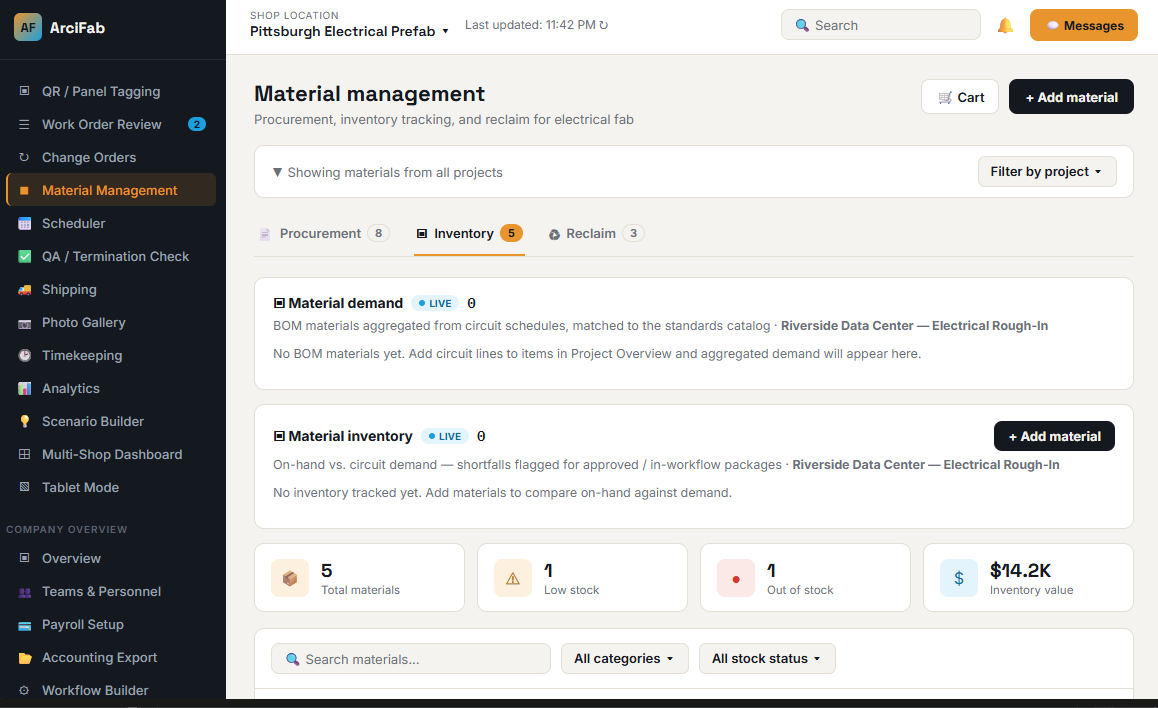
ArciFab product view — one system built around your process.
One environment. Your process. Owned — not rented by the seat.

The number that actually matters

Justify cost by what comes out, not what gets added

The real question was never "what does this feature do." It's how many logins your company can stop paying for. How many seats you can stop renewing. How many spreadsheets can quietly stop existing because the systems they were bridging aren't two systems anymore. That's a number you can put in front of a board without flinching — not a feature list, a reduction.

01

Fewer logins. Modules that replace stack pieces instead of stacking on top of them.

02

Fewer seats. Ownership structure instead of another renewal cycle per tool.

03

Fewer bridges. When the process lives in one place, the spreadsheet holding two systems together can die.


The decision is simple

Show us the stack you're paying for.

Bring the systems, the seats, and the spreadsheets holding it all together — and we'll show you exactly what can come out of it.

(Financing link redirects to a third-party website)